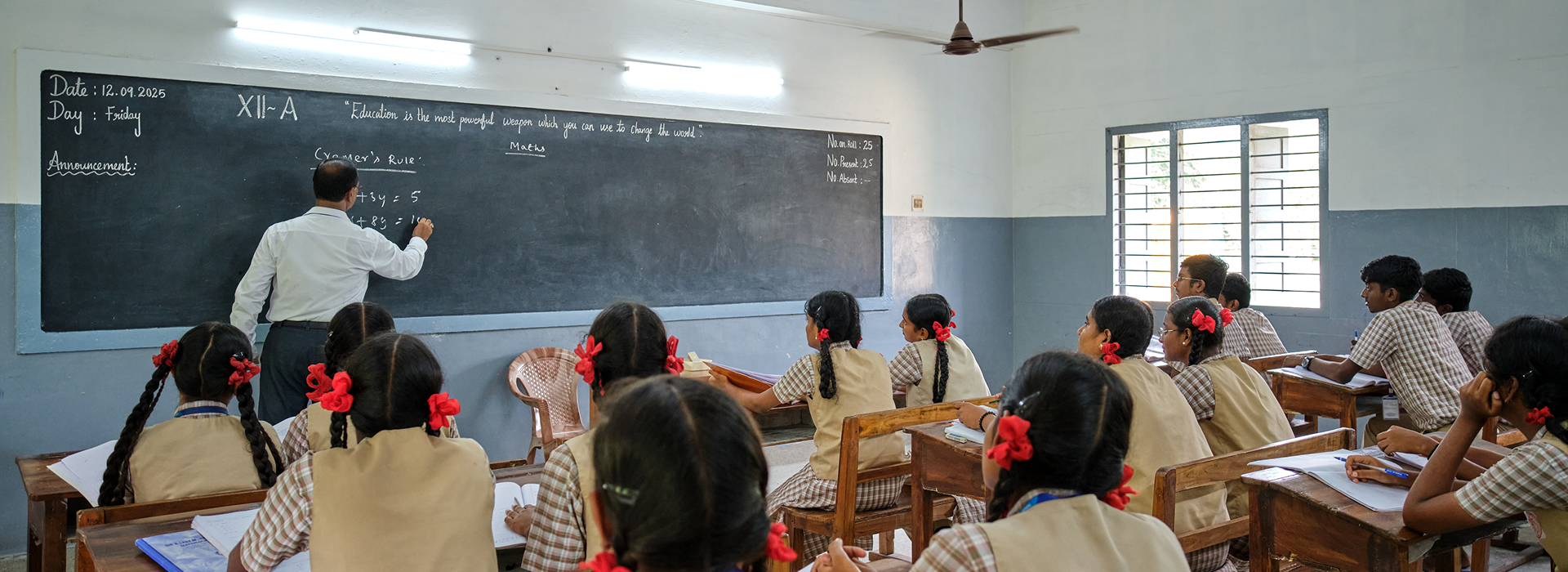
Academics
Inspiring purposeful learning that shapes bright futures

CURRICULUM OVERVIEW

LKG & UKG
Ages 3.5 to 5
Joyful, play-based learning building early skills, confidence, curiosity, creativity, and independence.

Grades 1 to 5
Ages 6 to 10
Concept-based learning that strengthen skills, communication, curiosity, confidence, creativity, and growth.

Grades 6 to 10
Ages 11 to 15
Advanced learning developing critical thinking, confidence, discipline, leadership skills, and life readiness.
Grades 11 & 12
Ages 16 to 18
Specialised learning preparing students with expertise, confidence, discipline, career focus, and clarity.
ASSESSMENTS
Continuous evaluation of class tests, assignments, and projects. These assessments help track daily learning progress and provide immediate feedback to students and parents.
To evaluate students' overall academic progress, the school conducts the following summative assessments throughout the academic year:
These exams are designed to comprehensively assess the knowledge, understanding, and application of concepts taught during each term.
• The grade system is followed for Assessment from LKG to Std. VIII. • For Std. I to VIII, Formative Assessment carries 40% and Summative Assessment carries 60%. Students must score a minimum of 14 marks in FA and 21 marks in SA to pass.
| FA | SA | TOTAL | |||
|---|---|---|---|---|---|
| Marks | Grade | Marks | Grade | Marks | Grade |
| 37–40 | A1 | 55–60 | A1 | 91–100 | A1 |
| 33–36 | A2 | 49–54 | A2 | 81–90 | A2 |
| 29–32 | B1 | 43–48 | B1 | 71–80 | B1 |
| 25–28 | B2 | 37–42 | B2 | 61–70 | B2 |
| 21–24 | C1 | 31–36 | C1 | 51–60 | C1 |
| 17–20 | C2 | 25–30 | C2 | 41–50 | C2 |
| 13–16 | D | 19–24 | D | 33–40 | D |
| 9–12 | E1 | 13–18 | E1 | 21–32 | E1 |
| 8 & below | E2 | 12 & below | E2 | 20 & below | E2 |
POLICY
The school maintains a zero-tolerance policy toward any form of cheating or malpractice during examinations. Any act of dishonesty will be dealt with severely, and appropriate disciplinary action will be taken. Examples of such misconduct include, but are not limited to:
Students are expected to uphold the highest standards of integrity. Violations may result in the cancellation of the exam, suspension, or further disciplinary measures.

CONNECT
Our academic office is here to assist you with any
queries or concerns.

Prefer to call? Reach us at
+044 2226 1142